by Robert Borges on October 19, 2026
Texas vs. Florida for Retirement: Which State Fits Your Lifestyle Best?

Thinking about retiring in Texas or Florida? You're not alone. Both states attract retirees and active adults with warm weather, favorable tax policies, outstanding golf, and a growing selection of retirement communities. But when it comes to affordability, homeownership costs, and everyday lifestyle, there are some important differences.
Texas generally offers lower home prices, more space, and a wider variety of inland living options. Florida stands out for its beaches, coastal recreation, mild winters, and extensive selection of 55+ communities. Both have no state individual income tax, but property taxes, homeowners insurance, and local living costs can make a significant difference in your retirement budget.
So, is Texas or Florida better for retirement? Let's compare the factors that matter most.
In this article, we’ll explore:
Affordability
Taxes
Weather
Outdoor Recreation
Golf & 55+ Communities
Healthcare
Pros & Cons
Finding the Right Community
Texas vs. Florida: At a Glance
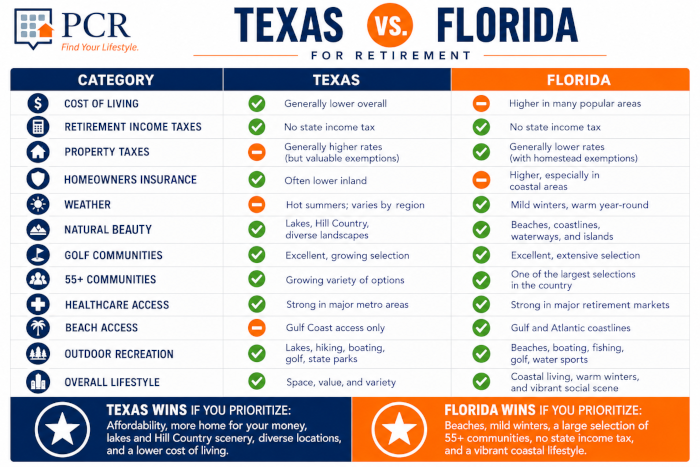
Is Texas Cheaper Than Florida for Retirement?
For many retirees, Texas offers a lower overall cost of living than Florida, especially when comparing housing prices.
However, statewide averages don't tell the whole story. Housing costs vary significantly by location, and buyers can research regional trends through market reports published by Texas REALTORS and Florida Realtors.
Popular Texas destinations such as Austin and parts of the Dallas-Fort Worth metropolitan area can be expensive. Meanwhile, Florida communities around Ocala, inland Central Florida, and portions of North Florida may offer more affordable alternatives to coastal markets.
What Should Retirees Compare?
Beyond the purchase price, consider:
- Property taxes and available exemptions
- Homeowners and flood insurance
- HOA fees and community assessments
- Utilities and summer cooling costs
- Healthcare expenses
- Transportation and everyday living costs
A less expensive Texas home might come with higher annual property taxes, while a Florida home with a lower tax bill could carry considerably higher insurance premiums.
Bottom Line:
Texas generally has the affordability advantage, but comparing the total annual cost of owning a home is more useful than comparing purchase prices alone.
Which State Has Better Taxes for Retirees?
Here's some good news: Neither Texas nor Florida has a state individual income tax.
That means neither state taxes Social Security benefits, pension income, IRA withdrawals, or 401(k) distributions at the state level.
For retirees relocating from a state with significant income taxes, either destination may offer substantial savings.
The more meaningful difference is often property taxes.
Texas Property Taxes
Texas generally has higher effective property tax rates than Florida, although the amount varies by county, school district, and local taxing authority.
The state offers several protections for eligible homeowners, including residence homestead exemptions.
Qualifying homeowners can receive a $140,000 school district homestead exemption, with an additional $60,000 exemption for qualifying homeowners age 65 or older or disabled. Additional local exemptions and limitations may apply.
Florida Property Taxes
Florida generally has lower effective property tax rates than Texas.
Eligible permanent residents may qualify for Florida's homestead exemption, which can reduce taxable property value. The state's Save Our Homes assessment limitation also restricts annual increases in assessed value for qualifying homestead properties.
Some Florida counties and municipalities offer additional exemptions for eligible older homeowners.
Bottom Line:
It's a tie for retirement income taxes, but Florida generally has an advantage in effective property tax rates. Texas retirees should investigate available homestead and age-based exemptions before estimating their annual tax bills.
Homeowners Insurance: Is Texas or Florida More Expensive?
Insurance is one of the most important—and sometimes overlooked—costs of retirement homeownership.
Florida homeowners face exposure to hurricanes, flooding, and other weather-related risks. Texas homeowners also face severe thunderstorms, hailstorms, tornadoes, flooding, and hurricanes along the Gulf Coast.
Before purchasing in either state, obtain property-specific insurance estimates, review your home's exposure using the FEMA Flood Map Service Center, and determine whether separate flood or windstorm coverage is needed.
Bottom Line:
Texas often has the insurance advantage, particularly inland. Florida buyers should carefully evaluate premiums, deductibles, flood zones, and long-term insurance affordability.
Which State Has Better Weather?
Both states are known for warm weather, but the climates aren't identical.
Texas Weather

Texas is enormous, and its climate varies considerably.
Central Texas and the Hill Country experience hot summers and generally mild winters, while northern areas around Dallas-Fort Worth can see occasional freezing temperatures and winter storms.
West Texas is typically drier, while Houston and the Gulf Coast experience greater humidity.
For retirees who enjoy seasonal variety without consistently harsh winters, parts of Texas can be especially appealing.
Florida Weather

Florida offers a more consistently subtropical climate, with particularly mild winters in southern and coastal areas.
Summers are hot and humid, with frequent thunderstorms. Tropical storms and hurricanes are important considerations, particularly for coastal homeowners. Retirees considering coastal property can consult the NOAA National Hurricane Center for hurricane information, historical storm data, and preparedness resources.
Florida's warm winters remain one of its biggest advantages for retirees seeking year-round outdoor recreation.
Bottom Line:
Florida generally wins for mild winters. Texas offers more climate variety, including drier inland regions and locations with more noticeable seasonal changes.
Which State Offers Better Outdoor Recreation?

This is where personal preference really comes into play.
Outdoor Living in Texas
Texas offers an impressive range of recreational opportunities, including:
- Boating and fishing on lakes such as Travis, LBJ, and Conroe
- Hiking and scenic drives throughout Texas Hill Country
- Golf at public, private, and master-planned communities
- State parks, nature trails, and wildlife viewing
- Coastal fishing and boating along the Gulf
- Cycling, pickleball, and outdoor fitness
The Texas Hill Country is especially appealing to active adults who appreciate rolling landscapes, lakes, wineries, historic towns, and scenic outdoor settings.
Outdoor Living in Florida
Florida's outdoor lifestyle revolves heavily around water, sunshine, and recreation.
Popular activities include:
- Beach walking and swimming
- Boating, sailing, and fishing
- Kayaking and paddleboarding
- Golf and tennis
- Pickleball and cycling
- Wildlife viewing and nature preserves
- Waterfront dining and coastal recreation
Florida also offers numerous golf, waterfront, and active adult communities designed around recreation and social engagement.
Bottom Line:
Choose Texas for lakes, Hill Country scenery, and diverse inland recreation. Choose Florida for beaches, boating, and a coastal lifestyle. Both are excellent choices for golfers and outdoor enthusiasts.
Which State Has Better Golf and 55+ Communities?

Texas and Florida are among the country's most appealing destinations for active adults who want to live in communities centered around recreation, wellness, and social activities.
Texas Retirement Communities
Texas offers an expanding selection of 55+, golf, gated, and master-planned communities.
Popular retirement regions include:
- Georgetown and Sun City: Established active adult living north of Austin
- Austin and Texas Hill Country: Golf, lakes, trails, and scenic landscapes
- San Antonio and Boerne: Hill Country living with urban conveniences
- Dallas-Fort Worth suburbs: Master-planned neighborhoods and access to metropolitan amenities
- Houston-area communities: Golf, recreation, and a broad range of housing options
Many Texas communities feature golf courses, fitness centers, swimming pools, pickleball, walking trails, and organized clubs.
Florida Retirement Communities
Florida has one of the nation's most extensive selections of 55+ and active adult communities.
Popular destinations include:
- Ocala and Central Florida: Established retirement destinations and relatively affordable inland options
- Sarasota and Venice: Gulf Coast recreation, golf, and cultural amenities
- Naples and Fort Myers: Golf, boating, beaches, and luxury communities
- Daytona Beach and Palm Coast: Coastal recreation and active adult living
- Port St. Lucie and the Treasure Coast: Golf, waterfront recreation, and master-planned neighborhoods
Florida communities frequently offer resort amenities, social programming, golf, fitness facilities, pickleball, and opportunities for year-round outdoor recreation.
Bottom Line:
Florida has the advantage in the breadth of established 55+ retirement communities. Texas is an excellent alternative for buyers seeking newer master-planned neighborhoods, larger homes, golf, and scenic inland settings.
Which State Has Better Healthcare?
Both Texas and Florida have major healthcare systems and nationally recognized medical institutions.
Texas retirees near Houston, Dallas, Austin, and San Antonio can access extensive hospital networks and specialty medical care. Houston's Texas Medical Center is particularly well known for its concentration of healthcare institutions.
Florida also has established healthcare networks in major retirement destinations, including Tampa, Jacksonville, Orlando, Sarasota, Naples, and Southeast Florida.
Facilities such as Mayo Clinic in Jacksonville, Cleveland Clinic Florida, and major university-affiliated health systems provide specialized medical services.
However, access can be more limited in rural areas of either state.
When comparing retirement communities, consider proximity to primary care, specialists, hospitals, and facilities that accept your health insurance or Medicare Advantage plan. The official Medicare Care Compare tool allows buyers to research and compare healthcare providers and facilities in specific locations.
Bottom Line:
Both states offer strong healthcare in major metropolitan areas. The better choice depends on the specific community, available providers, and your individual medical needs.
Texas vs. Florida: Pros and Cons

Pros of Retiring in Texas
- No state individual income tax
- Generally lower home prices
- Spacious homes and master-planned communities
- Lakes, Hill Country scenery, and outdoor recreation
- Excellent golf opportunities
- Major metropolitan amenities
- More inland locations away from coastal hurricane exposure
Potential Drawbacks
- Higher property tax rates in many areas
- Extremely hot summers
- Severe storms, hail, and tornado risks
- Some communities require significant driving
- Fewer established 55+ communities than Florida
Pros of Retiring in Florida
- No state individual income tax
- Mild winters
- Beautiful Gulf and Atlantic beaches
- Extensive selection of 55+ communities
- Outstanding boating and golf
- Established retirement destinations
- Numerous recreation and social opportunities
Potential Drawbacks
- Higher homeowners insurance costs in many markets
- Hurricane and flooding risks
- Hot, humid summers
- Higher housing costs in popular coastal areas
- Seasonal traffic and tourism
Our Recommendation: Texas or Florida for Retirement?
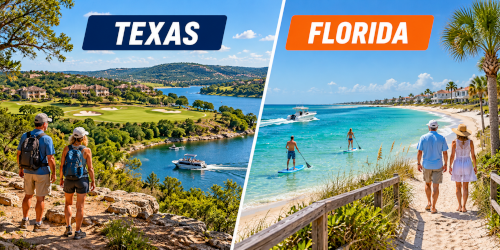
Texas is generally the better choice for retirees who prioritize housing affordability, space, and diverse inland lifestyles. Florida is often the stronger choice for those seeking beaches, mild winters, and an extensive selection of active adult communities.
Neither state is universally better.
A retiree comparing a golf community near Georgetown, Texas, with an active adult community in Ocala, Florida, may find similar amenities but very different ownership costs and surroundings.
Likewise, comparing a Hill Country lake community with a Gulf Coast waterfront development presents two distinctly different lifestyles.
Before deciding, evaluate the total cost of homeownership, healthcare access, amenities, and how each destination fits your long-term plans.
The best retirement destination isn't necessarily the one with the lowest taxes or the most sunshine. It's the one that offers the lifestyle you want at a cost you can comfortably maintain.
Frequently Asked Questions
Is Texas or Florida cheaper for retirement?
Texas is generally more affordable overall, particularly when comparing statewide home prices. However, Texas often has higher property taxes, while Florida can have higher homeowners insurance costs. Individual cities and communities may differ considerably.
Does Texas or Florida tax Social Security or retirement income?
Neither state has a state individual income tax, so neither taxes Social Security benefits, pensions, or retirement account withdrawals at the state level. Federal taxes may still apply.
Which state has lower property taxes?
Florida generally has lower effective property tax rates. However, Texas offers significant homestead exemptions and additional benefits for eligible homeowners age 65 and older.
Is Florida or Texas better for 55+ communities?
Florida offers a larger selection of established 55+ communities, many with extensive amenities and organized activities. Texas also has excellent active adult communities, particularly around Austin, Georgetown, San Antonio, Dallas-Fort Worth, and Houston.
Which state has better weather for retirees?
Florida generally has milder winters, especially in southern regions. Texas offers greater climate variety, although summers can be extremely hot and northern regions experience occasional winter freezes.
Ready to Compare Texas and Florida Communities?
Now that you've compared the advantages of retiring in Texas versus Florida, the next step is finding the right community.
For 30 years, Private Communities Registry (PCR) has helped homebuyers explore amenity-rich lifestyle communities across the country.
Whether you're interested in a Texas Hill Country golf community, a spacious master-planned neighborhood near Austin, a Florida coastal development, or a 55+ community with resort amenities, PCR makes it easy to discover and compare your options.
Texas Communities

Discover Texas communities featuring golf, lakes, walking trails, fitness facilities, gated neighborhoods, and active adult living.
Florida Communities
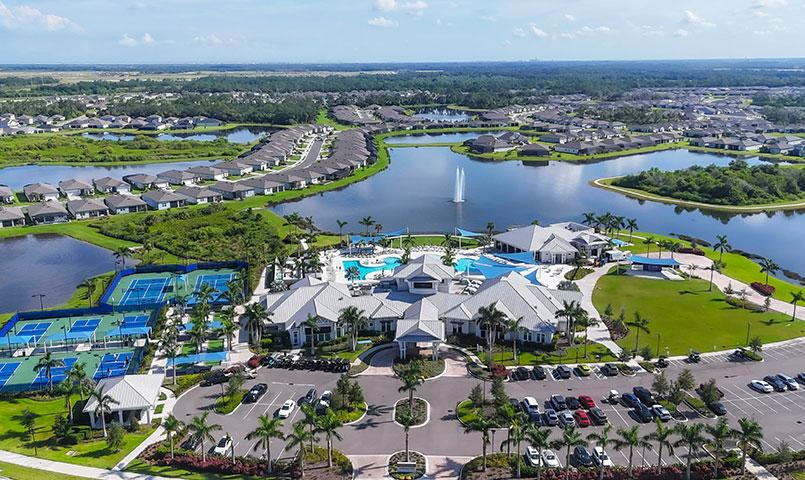
Search Florida communities offering beaches, boating, championship golf, pickleball, wellness amenities, and established 55+ lifestyles.
Still weighing your options?
Compare communities side by side, request information directly from developers, and discover the destination that best matches your retirement goals.
About the Author
With over 20 years of experience as a seasoned content creator, Robert Borges is the senior writer for Private Communities Registry (PCR), specializing in real estate trends and master-planned communities. He works closely with builders, developers, and real estate pros to create helpful content that guides homebuyers in finding the perfect community, ensuring they have the information needed to make confident, informed decisions.